
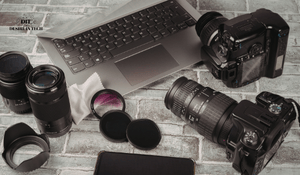

Digital Photography: Exploring The Best Digital Cameras of 2026

Desire E
Discover the magic of digital photography in 2026 with our guide to the best digital cameras. Learn how to choose the right starter camera and master essential camera settings for creative control, from aperture to ISO. Dive into techniques for capturing stunning photos and explore the features of DSLRs and mirrorless cameras perfect for beginners.
Mastering Digital Photography: Best Cameras 2026
Choosing a new camera can feel like decoding a secret language. You’re hit with a wall of specs like 'f/1.8' and 'APS-C,' leaving you to wonder what any of it actually means for your photos. The problem isn't the jargon; it's that you're being sold features before you understand the fundamentals. This guide teaches you those fundamentals first, so you can choose the right camera with complete confidence.
For most of us, 'Auto' mode is our camera's trusty co-pilot, but it's still just a computer making its best guess. What if you were the pilot? In practice, the 'best' camera isn't the most expensive one; it's the one that gives you the creative control you need to bring your vision to life. The real magic of digital photography is in the artist, not just the tool. Learning the craft before you invest in complex gear is the most important first step.
Unlocking that creative control isn't nearly as complicated as it sounds. It all comes down to understanding just three core settings that work together as a team. These are Aperture (which creates those beautifully blurry backgrounds), Shutter Speed (which freezes fast motion or turns it into a silky blur), and ISO (which helps you take clear photos in low light). Mastering how they interact is the key to moving beyond 'Auto' mode forever.
This journey will teach you how to think like a photographer. You'll understand exactly why certain features matter, making your choice clear and simple. Whether you are just getting started with a DSLR or looking for the best budget camera for beginners, this knowledge is the only specification that truly matters. Let's start building your confidence.
How to Get That Professional Blurry Background (It's All About Aperture)
Have you ever seen a portrait where the person is perfectly sharp, but the background melts away into a beautiful, soft blur? That stunning effect isn’t some complicated trick; it’s created by controlling a single setting called aperture. The easiest way to understand aperture is to think of it as the pupil of your camera’s eye. It can open wide to let in more light or shrink to a pinpoint to let in less.
Beyond just controlling brightness, the size of that opening also determines your depth of field—a fancy term for how much of your photo is in focus from front to back. This is where the magic happens. A wide-open aperture creates a “shallow” depth of field, throwing the background out of focus. This is measured in f-stops, and here’s the key: a small f-stop number (like f/1.8) means a large opening and a very blurry background, perfect for making your subject pop. A large f-stop number (like f/11) means a small opening and keeps nearly everything sharp.
You don’t have to learn everything at once to use this. Your camera likely has a semi-automatic mode called Aperture Priority, labelled “A” or “Av” on the mode dial. When you switch to this mode, you get to pick the f-stop to control the background blur, and your camera cleverly handles the rest of the settings for a perfectly lit photo. It’s the ideal way to take creative control without feeling overwhelmed.
So, for your next portrait, try it out: switch to Aperture Priority mode, select the lowest f-stop number your lens can manage, and focus on your subject. You’ve just taken a huge step from simply taking a picture to making one. But what about when your subject is a fast-moving child or pet? For that, we need to talk about the secret to freezing motion.
The Secret to Taking Perfectly Sharp Photos of Moving Subjects
If aperture controls how much light enters your camera, the next piece of the puzzle, shutter speed, controls how long that light gets in. Think of it as your camera's eyelid. Shutter speed is simply the amount of time that eyelid stays open. A quick blink lets in a tiny slice of time, while a long, slow blink captures a wider duration of a moment. This single setting is the key to mastering photos with any kind of movement.
For those fast-moving moments—your dog catching a frisbee, your daughter scoring a goal, or a bird taking flight—you need to use a fast shutter speed. A setting like 1/1000th of a second (written as 1/1000s) acts like a flash of lightning, freezing your subject in a single, crisp instant. This completely eliminates the motion blur that turns an exciting action shot into a disappointing smear, giving you that perfectly sharp, 'caught in the act' photo.
On the other hand, a slow shutter speed can be used for creative effects. By leaving the shutter open for a full second or more, any moving lights, like cars on a highway at night, will paint beautiful streaks across your photo. This same technique can turn a cascading waterfall into a silky, dream-like flow. It's proof that blur isn’t always bad; sometimes it can make your photo more interesting.
Just like with aperture, your camera has a handy mode to help you practise. Look for Shutter Priority on your mode dial, often labelled “S” or “Tv” (for Time Value). In this mode, you choose the shutter speed you want, and the camera automatically selects the right aperture to get a good exposure. It’s the perfect way to start telling your camera exactly how to capture motion. But what happens when it's too dark to use a fast shutter speed? For that, we need to introduce the third member of our team.
Why Are My Indoor Photos So Grainy? A Guide to ISO
Struggling to take a sharp photo indoors without it being a blurry mess? This is where the third hero of exposure, ISO, comes to the rescue. Think of ISO as your camera’s digital sensitivity to light. A low ISO (like 100) is for bright, sunny days. A high ISO (like 3200) makes your camera more sensitive, helping you 'see in the dark' when changing your aperture or shutter speed isn't enough to get a bright photo.
This digital brightening comes with a trade-off, however. As you raise the ISO, you introduce digital noise—that grainy, speckled texture you often see in photos taken at night. It’s the price you pay for getting a usable, sharp shot in dim conditions. A high ISO lets you capture the moment without blur, but at the cost of that perfectly smooth, clean look you get in good light.
For the best quality, the rule is simple: keep your ISO as low as the light allows. On a bright day, use your camera's base ISO (usually 100 or 200). Only increase it when you must, like when you're indoors or as the sun sets, to get a sharp, well-lit shot. You've now met the three core elements that control your camera's exposure. But how do they actually work together as a team?
The Exposure Triangle: How Aperture, Shutter Speed, and ISO Work as a Team
The three core settings—aperture, shutter speed, and ISO—are an inseparable team that controls the single most important aspect of your picture: its exposure, or overall brightness. This fundamental relationship is known as the Exposure Triangle, and understanding it is the key to leaving 'Auto' mode behind for good. Your goal is to balance these three elements to create a photo that’s not too dark and not too bright.
To make sense of this, imagine you’re filling a bucket with water. The final amount of water is your correct exposure. You have three ways to control the flow:
- Aperture is the width of the hose.
- Shutter Speed is how long you turn the water on.
- ISO is the water pressure.
If you use a very narrow hose (a small aperture), you’ll need to leave the water on longer (a slower shutter speed) to fill the bucket. If you only have a split second to turn the water on (a fast shutter speed), you’ll need a very wide hose or very high pressure to get the job done. This constant trade-off is the heart of shooting in manual mode.
This balance is where your creative control comes from. It’s the secret to telling your camera what you want, whether it’s a beautifully blurred background or tack-sharp frozen action. Mastering this gives you control over the light entering your camera, but what about the digital information your camera actually saves? That choice is just as crucial.
RAW vs. JPEG: Which File Format Is Right For a Beginner?
When you press the shutter button, your camera doesn't just capture light; it saves that information into a file. The two most common types are JPEG and RAW, and the one you choose has a huge impact on your photos. Think of a JPEG as a finished photograph. Your camera processes the image, making decisions about colour, sharpening, and brightness, then compresses it into a small, convenient file that’s ready to share immediately. It’s simple and efficient.
A RAW file, on the other hand, is like a digital negative. It’s a much larger file that contains all the unprocessed, uncompressed image data straight from your camera’s sensor. This might not sound useful at first, but its power is revealed during post-processing (editing your photos on a computer or phone). Because a RAW file holds so much more information, it gives you incredible flexibility to fix mistakes or make creative adjustments, like rescuing a photo that's too dark or changing the colours without degrading the image quality.
So, which should you use? For beginners, there's no shame in starting with JPEG. It's easy, and the files are ready for social media or email. However, if you're curious about editing, the best way to learn is by switching your camera to its 'RAW+JPEG' mode. This gives you both a ready-to-share JPEG and a powerful RAW file to experiment with.
RAW: Pros: Maximum editing flexibility, higher quality. Cons: Large file size, requires editing software.
JPEG: Pros: Small file size, ready to share instantly. Cons: Limited editing options, lower quality.
While file formats give you power after the shot, your most important creative decisions happen before you click.
Beyond Point-and-Shoot: 3 Simple Techniques for Better Photo Composition
The way you arrange the elements in your photo—its composition—is one of the most powerful tools you have. A great starting point is the Rule of Thirds. Imagine a noughts-and-crosses grid over your screen. Instead of placing your subject smack in the centre, try positioning it along one of the lines, or even better, where two lines intersect. This simple shift creates a more balanced and visually pleasing image that feels less like a snapshot and more like a deliberate photograph. Most cameras and phones even have an option to display this grid to help you practise.
Another powerful technique is to look for leading lines. These are natural lines within your scene—like a winding path, a fence, or a riverbank—that guide the viewer’s eye. When you compose your shot, think about how these lines can draw attention toward your main subject. This creates a sense of movement and direction, making your photo feel much more dynamic and engaging than a static scene.
To add a wonderful sense of depth, try using a natural frame within your scene. Look for elements in the foreground, like an overhanging tree branch, a doorway, or a window, to shoot through. By placing this 'frame' around your subject, you create context and draw the viewer deeper into the image, making it feel more three-dimensional and immersive. It’s a simple trick used constantly in both photography and film.
These aren't strict rules, but rather creative guides to help you see the world differently through your lens. Mastering them will dramatically improve your photos, regardless of the camera you use. As your skills grow, however, you might start wondering if different types of cameras could unlock even more creative possibilities.
DSLR vs. Mirrorless: What's the Real Difference for a Beginner?
As you start exploring cameras with interchangeable lenses, you'll constantly hear two terms: DSLR and mirrorless. The choice can feel overwhelming, but for a beginner, the main difference boils down to a single, tiny part: a mirror. This one component changes how you see your shot and how the camera feels in your hands.
A DSLR (Digital Single-Lens Reflex) uses an internal mirror to bounce the light coming through the lens up into an optical viewfinder. This means when you look through the eyepiece, you're essentially looking through a clear glass window at the actual scene. It’s a direct, lag-free view, but it doesn't show you how your settings will affect the final photo until after you’ve taken it.
Mirrorless cameras, on the other hand, remove that mirror entirely. This makes them generally smaller and lighter. Instead of a direct optical view, they use an electronic viewfinder (EVF)—a tiny, high-resolution screen inside the eyepiece. This is a game-changer for learning because it shows you a live preview of your image. As you adjust your settings, you’ll see the exposure change in real-time, taking the guesswork out of getting the right brightness.
One last factor to consider is the sensor size, which is the digital equivalent of film. Most affordable DSLRs and mirrorless models use an APS-C sensor, offering an excellent balance of image quality, cost, and compact size. You’ll also hear about Full-Frame sensors, which are larger, gather more light, and are typically found in more expensive, professional cameras. For your first camera, an APS-C model provides the perfect starting point. But no matter which camera you choose, the real magic often happens after the shot.
Your First 5-Minute Photo Edit: How to Make Your Photos Pop
Taking the picture is only half the story. The small adjustments you make afterward—a process called post-processing or editing—can transform a good photo into a great one. You don't need complicated software; most phones have these tools built right in. The most powerful first step is often the simplest: the crop. Cropping allows you to recompose your shot, removing distracting elements from the edges and pulling focus directly to your subject. It's your second chance to perfect the framing and can instantly make an image feel more intentional.
Once your composition is set, focus on light and impact. Nearly every editing app has two essential sliders: Exposure and Contrast. Think of Exposure as the master brightness control; it makes the entire image brighter or darker. If your photo looks a little gloomy, a slight nudge of the exposure slider can bring it back to life. Contrast, on the other hand, adds 'punch.' It makes the dark parts of your image darker and the light parts lighter, preventing the photo from looking flat or washed-out. These two tools are the workhorses of photo editing.
With the brightness and impact dialled in, the final touch is colour. The Saturation slider controls the intensity of the colours in your photo. A small boost can make a blue sky bluer and green grass more vibrant, but be careful—a little goes a long way. Over-saturating a photo can make it look artificial. For a fast, effective workflow, just follow these steps in order:
- Straighten & Crop: Fix the composition first.
- Adjust Exposure: Get the overall brightness right.
- Increase Contrast: Add depth and impact.
- Boost Saturation/Vibrance: Make the colours pop, carefully.
You're No longer a Beginner: Your Action Plan for Better Photography
You’re no longer just a passenger letting 'Auto' mode steer. You’ve taken the controls, understanding how aperture, shutter speed, and ISO work together to shape a photograph. Where you once saw a blurry or dark image as a mistake, you now see an opportunity—a setting to adjust, a creative choice to make. The power to create a creamy, blurred background or capture a sharp photo of a speeding pet is no longer a mystery; it’s a skill you now possess.
The best way to turn this new knowledge into instinct is to practise one skill at a time. Put your camera into a 'priority' mode and follow this simple plan to master digital photography:
- Week 1: Use Aperture Priority (A/Av). Focus only on creating depth, making your subject pop against a soft background.
- Week 2: Switch to Shutter Priority (S/Tv). Your only goal is to control motion—freezing action or blurring it beautifully.
- Week 3: Try full Manual (M). Now that you understand the pieces, see how the benefits of shooting in manual mode come together in a simple, well-lit environment.
Remember, the goal isn’t technical perfection; it’s creative expression. You now know that the best camera isn't the most expensive one, but the one you understand how to use. So give yourself permission to experiment, to take 'bad' photos, and to have fun. Every click of the shutter is a step forward on your new creative journey.
